Holly Jolly Illustrations
As someone who’s launched over 200 digital products across Etsy, Creative Fabrica, and Shopify—mostly seasonal design assets for crafters and small business owners—I opened Holly Jolly with a very specific question: *Does this illustration land with enough visual clarity and commercial flexibility to justify adding it to my next holiday bundle?*
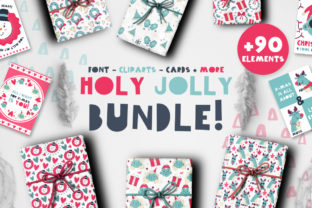
First impression? Warm, intentional, and quietly confident. Holly Jolly isn’t shouting “CHRISTMAS!”—it’s leaning into a refined festive mood: soft botanical holly sprigs intertwined with delicate berries and subtle gold foil accents. It feels handmade but polished, joyful but not childish, traditional but not dated. The palette leans into deep forest greens, muted cranberry, cream, and just enough metallic warmth to suggest premium printable quality—not glittery overload. That makes it ideal for buyers who sell in niches like modern farmhouse decor, minimalist gift shops, boutique stationery, or wellness-adjacent holiday branding.
This isn’t a clipart pack full of isolated elements—it’s a cohesive illustration, designed as a single focal composition. That changes how you use it. You’ll want to treat Holly Jolly as a core visual anchor rather than a scatter element. Think: the central motif on a greeting card front, the hero graphic in a Canva invitation template, the wrap-around pattern on a tumbler design, or the featured art in a set of printable wall prints.
In real product-building scenarios, I tested Holly Jolly across six common formats—and here’s where it shined:
- Printable wall art: Scaled cleanly to 8x10", 11x14", and 16x20" with zero pixelation. The contrast between green and cream holds up beautifully on matte paper.
- SVG designs for Cricut projects: The included vector file has smooth, closed paths and minimal anchor points—no jagged edges when cut on vinyl or cardstock. Works reliably for sticker sheets and layered wood signs.
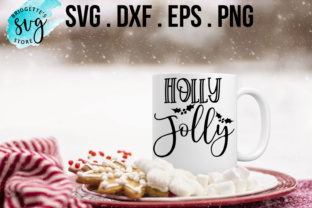
- Mug and tote bag designs: As a centered sublimation design, it reads clearly at 3–4 inches tall. The negative space around the illustration gives breathing room—critical for print-on-demand platforms where bleed and alignment vary.
- Canva templates: Paired effortlessly with serif (Playfair Display), sans serif (Montserrat), and script fonts (Dancing Script). Its balanced weight doesn’t overwhelm typography—ideal for social media graphics or digital planners.
- Digital download bundles: Stands out in thumbnail previews thanks to strong silhouette recognition and warm color contrast. Tested on Etsy’s mobile grid: it caught attention faster than busier, more saturated alternatives.
- Product mockups: Rendered convincingly on rustic wood frames, ceramic mugs, linen tea towels, and kraft gift tags—enhancing perceived value without needing heavy editing.
Where Holly Jolly supports brand consistency most is in visual storytelling. If your shop sells cohesive seasonal collections—say, a “Winter Hearth” line with matching planner stickers, recipe cards, and gift tags—this illustration becomes the unifying thread. It helps customers recognize your style across product types, builds trust through repetition, and strengthens small business branding without requiring custom illustration work each season.
That said, it’s not universally plug-and-play. Use Holly Jolly carefully in these situations:
- Tiny sticker sheets: At under 0.5" tall, the berry details blur. Reserve it for medium-to-large die-cut stickers (1.5"+) or as a background layer beneath bolder text.
- Text-heavy templates: Its organic shape doesn’t lend itself to tight grid layouts. Avoid cramming it beside dense paragraphs or multi-line quotes.
- Dark background applications: The cream tones fade unless you manually adjust brightness or add a subtle drop shadow. Always preview on black or navy mockups before publishing.
- Low-resolution print products: While the PNG is 300 DPI, compressing it for email-friendly PDFs or web previews can mute contrast. Keep original files separate for print fulfillment.
Before listing any product using Holly Jolly, I ran five quick seller checks:
- Opened the PNG in Photoshop and confirmed full transparency—no stray white pixels around stems or berries.
- Imported the SVG into Cricut Design Space and ran a test cut on scrap vinyl—clean lines, no double-cutting or nesting issues.
- Placed it on three different mockup backgrounds (white, charcoal, kraft) to assess contrast and legibility.
- Uploaded a thumbnail-sized version (200px wide) to an Etsy listing preview tool—still instantly recognizable as festive and high-quality.
- Double-checked the commercial license: yes, it permits finished goods (including print-on-demand), digital downloads, and resale in bundled design assets—no attribution required.
For Canva template sellers, Holly Jolly works best as a hero image—not filler. Drop it into a holiday newsletter header, a blog post banner, or a Pinterest pin for “cozy Christmas printables.” Its quiet elegance lifts the perceived professionalism of your entire digital product lineup.
Crafters building physical kits will appreciate how easily it adapts: trace it for embroidery patterns, layer it behind vellum for lantern decals, or use it as a guide for hand-lettered chalkboard signs. For packaging design, it adds instant seasonal charm to gift box labels or tissue paper prints—without looking mass-produced.
One final note: Holly Jolly doesn’t try to be everything. It’s not a maximalist party scene or a cartoon reindeer bundle. Its strength lies in focused, versatile elegance—a graphic design asset that earns its place in a thoughtful, scalable product catalog. If your audience values craftsmanship over clutter, warmth over wattage, and cohesion over chaos, this illustration delivers measurable ROI—not just in listings sold, but in repeat customers recognizing your visual voice across seasons.