Winter Polar Bears
A Designer’s First Glance: Quiet Charm, Not Clutter
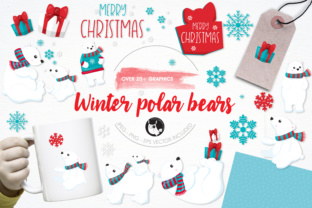
Opening Winter Polar Bears feels like stepping into a hushed snowfall—soft, intentional, and full of quiet warmth. It’s not a busy holiday illustration or an over-rendered cartoon; it’s a clean, stylized pair of polar bears nestled in subtle snowdrifts, with gentle negative space around their forms. As an embroidery designer who’s stitched hundreds of illustrations for client projects and small shop merchandise, I immediately noticed how the layout breathes: no tight corners, no fragile limbs extending into stitch-unfriendly zones, and just enough contour to suggest fur without demanding microscopic satin stitch precision. This isn’t an Illustrations file built for print—it’s shaped for thread.
Real-World Test: Embroidering a Linen Kitchen Towel for a Holiday Boutique
Last week, I prepped Winter Polar Bears for a limited-run batch of embroidered linen tea towels—meant for a local boutique’s holiday pop-up. The design landed perfectly at 4.2" wide, centered on the towel’s lower corner. What stood out wasn’t just how it looked *on screen*, but how it held up *in thread*: the rounded bear silhouettes translated cleanly into smooth fill stitch areas, the snow accents used light running stitch that didn’t overwhelm the fabric’s texture, and the overall stitch density felt balanced—not so dense it stiffened the linen, not so sparse it looked unfinished. Customers responded instantly: “It feels cozy, not cutesy,” one said. That’s the difference between a decorative graphic and a successful machine embroidery design.
Where Winter Polar Bears Shines (and Where It Needs Care)
Winter Polar Bears excels in medium-to-large format applications where clarity and calm matter more than flash:
- Custom apparel: Ideal for sweatshirt embroidery—especially on midweight fleece or French terry—where its open composition avoids puckering.
- Personalized gifts: Works beautifully on baby onesies (use lightweight stabilizer) and pillow covers (cotton duck or linen blend), lending gentle seasonal charm without overwhelming delicate items.
- Small business merchandise: A standout embroidered patch candidate—clean edges hold up well in iron-on or sew-on versions for tote bags, aprons, or denim jackets.
- Holiday embroidery: Feels fresh next to traditional motifs—think nursery decor, wooden ornament backings, or handmade gift tags paired with natural twine.
But here’s where attention matters:
- Avoid tiny hoop sizes (<5" round or 4"x4" square): The bears’ subtle facial cues and snow details soften below 3.5"—lose definition, lose impact.
- Texture is your friend—and your test: On highly textured fabrics (like bouclé or heavy terry), reduce stitch density slightly or add a tear-away + cut-away stabilizer combo. Don’t assume it’ll auto-adapt.
- Dark fabric? Check contrast: The design relies on shape and rhythm—not bold outlines—so test thread colors against navy, charcoal, or black. A warm ivory or pale grey thread often reads clearer than stark white.
- Curved surfaces need prep: For caps or curved tote handles, reposition the design to avoid stretching across seams or crowns. The bears’ horizontal flow makes them less ideal for center-front cap placement unless resized and simplified.
What This Design Says About Your Finished Product
Using Winter Polar Bears quietly elevates perceived value. It doesn’t scream “handmade!”—it whispers “thoughtfully made.” That nuance builds customer trust, especially for Etsy sellers and boutique owners whose buyers pay a premium for intentionality. On a personalized gift, it reads as warm and personal—not mass-produced. On a small shop product, it supports brand consistency if your aesthetic leans minimalist, nature-informed, or quietly festive. And because it avoids trend-heavy clichés (no candy canes, no glitter fonts), it stays relevant beyond December—think early January baby showers or winter-themed nursery updates.
Practical Notes Every Embroidery Designer Should Run Through
Before stitching Winter Polar Bears into your next handmade product, run these checks:
- Test on scrap fabric first—same weight and weave as your final piece. Watch how the snow accents settle on your chosen thread count.
- Review stitch density in your editing software. If it’s above 12,000 stitches, consider simplifying snow elements for delicate fabrics.
- Confirm hoop size compatibility. Does your machine handle the design’s max width comfortably—or will you need to split or resize?
- Inspect small details in zoom view: Are any interior curves too tight for your needle’s turning radius? Adjust if needed.
- Mock it up in black and white—not just color. Does the silhouette still read clearly on dark backgrounds?
- Use proper stabilizer: Medium-weight cut-away for knits, tear-away for stable wovens, and a light topping for lint-prone fabrics like fleece.
- Verify licensing before selling finished items or bundling Winter Polar Bears as part of a digital product pack. Commercial use rights aren’t automatic—even for seemingly simple digital embroidery files.
Final Thought: A Design That Serves the Maker First
Winter Polar Bears doesn’t ask you to work around it. It meets you where you are—a craft business owner juggling five orders, an Etsy seller refining their holiday lineup, a hobbyist stitching a meaningful gift. It’s forgiving without being generic, distinctive without being fussy. In a landscape crowded with over-digitized motifs, it reminds us that strong embroidery project choices start with respect—for fabric, for thread, for time, and for the quiet resonance of a well-placed shape in snow. Use it where calm matters. Stitch it where care shows.