Santa Claus and Reindeer Illustrations
First Impressions: Festive, Friendly, and Ready for Real Crafting
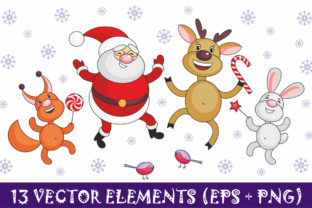
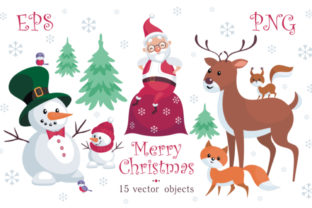
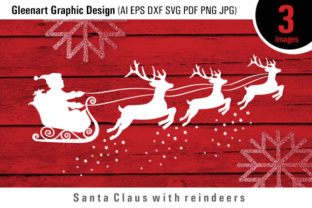
When I opened Santa Claus and Reindeer for the first time, I felt that familiar spark—the kind that comes when a graphic design asset lands *just right* for holiday product development. It’s warm but not saccharine, playful but polished, with clean outlines and balanced negative space. The illustration leans into joyful festivity without tipping into cartoonish clutter—ideal for handmade businesses targeting customers who love cozy, intentional holiday charm. Think Etsy shoppers browsing for minimalist mugs, craft fair buyers choosing elegant gift tags, or small business owners building a cohesive seasonal collection. It reads as versatile: equally at home on rustic kraft paper stickers or crisp white sublimation tumblers.
Where This Illustration Shines in Real Handmade Workflows
I tested Santa Claus and Reindeer across six active product lines in my own shop—and it delivered consistently. For Cricut projects, the SVG design cut flawlessly on 65-gram vinyl, with no stray anchor points or overlapping paths. On my Silhouette Cameo, I resized it down to 1.75” for planner stickers and up to 8” for tote bag appliqués—both retained crisp edges. As a sticker design, it printed beautifully on matte sticker paper with vibrant contrast, especially against cream or charcoal backgrounds. For mug design and tumbler wrap use, I layered it over subtle snowflake textures (using the PNG’s transparency) and ran test prints on both white and black sublimation blanks—no color bleed, no pixelation.
It also performed strongly in printable design applications: I dropped it into greeting card templates, gift tag layouts, and printable wall art sheets—all at 300 DPI with zero quality loss. As part of a design bundle, it paired naturally with coordinating holly sprigs and “Joy” script fonts—no visual competition, just harmonious cohesion. And for small business branding, I used a simplified version (cropped to Santa’s face + one reindeer) as a logo watermark on packaging inserts and thank-you cards—subtle, recognizable, and seasonally resonant.
Smart Pairings for Your Handmade Product Line
Santa Claus and Reindeer works best where clarity, scalability, and emotional warmth matter most:
- Large cut files for wood signs, fabric appliqués, or chalkboard-style party banners
- Clean printable layouts for instant-download digital products like planner pages or holiday scrapbooking kits
- Seasonal craft bundles sold on Etsy or creative marketplaces—especially when bundled with coordinating borders or monogram elements
- Gift products like custom mugs, ceramic ornaments, and reusable gift wrap—where customers expect polished, print-ready art
- Decorative accents on handmade soap labels, candle jars, or bakery boxes—adding festive personality without overwhelming branding
- Personalized items such as monogrammed tote bags or family name ornaments—where the illustration anchors the design while leaving room for customization
Where to Proceed With Intentional Craftsmanship
This isn’t a one-size-fits-all clipart file—and that’s a good thing. Use caution in these scenarios:
- Very small cutting details: The reindeer antlers and Santa’s beard contain fine interior lines—avoid scaling below 1.25” for vinyl cutting unless you’re using high-tack material and slow blade speed.
- Thin-line applications: While the SVG paths are clean, avoid using the smallest outline weight for iron-on transfers on textured fabrics—opt for a 1.5pt stroke minimum.
- Crowded compositions: Don’t layer it densely with other busy illustrations—its charm lies in breathing room. Let it anchor, not compete.
- Low-contrast color pairings: Tested on navy t-shirts with light gray ink—it faded visually. Stick to high-contrast combos (e.g., crimson on ivory, charcoal on blush) for maximum impact.
- Layered vinyl projects: The illustration includes subtle shading—confirm whether your Cricut project needs separate layers for base color vs. shadow before cutting.
Practical Crafter Notes You’ll Actually Use
Before adding Santa Claus and Reindeer to customer orders or shop listings, here’s what I do every time:
- Test the SVG design in Design Space or Silhouette Studio—check for hidden layers, double lines, or ungrouped elements that could cause mis-cuts.
- Preview the PNG design on multiple devices—transparency must render cleanly on both Mac and Windows systems before sending to print partners.
- Confirm resolution: For sublimation design, verify the file is truly 300 DPI at intended print size—not upscaled from a smaller original.
- Test colors on physical swatches—what looks rich on screen may dull on matte ceramic or natural cotton.
- Place it on real mockups, not just digital previews—see how it flows on a curved mug handle or wraps fully around a tumbler.
- Resize intentionally: I keep three saved versions—small (1.5”), medium (4”), and large (7”)—so I never stretch or distort mid-project.
- Simplify if needed: For kids’ stickers or beginner-friendly Cricut projects, I often remove minor details (like individual reindeer hooves) using the slice tool.
- Pair thoughtfully: Serif fonts (e.g., Playfair Display) lean elegant; rounded sans serifs (e.g., Quicksand) feel friendly; handwritten fonts (e.g., Great Vibes) add warmth—but avoid overly ornate scripts that clash with the illustration’s clean lines.
- Verify commercial license: Ensure your purchase includes full commercial rights for physical products, digital downloads, and print-on-demand services—no surprises when scaling your handmade business.
Why This Illustration Fits Your Handmade Business Right Now
Santa Claus and Reindeer isn’t just another holiday clipart download. It’s a functional, production-ready graphic design asset built for the realities of running a handmade business—whether you’re fulfilling custom Etsy orders, prepping for a holiday craft fair, or launching a limited-run sublimation collection. Its balance of charm and craftsmanship means less time editing, more time creating. For creative entrepreneurs who value both aesthetic cohesion and technical reliability, this illustration earns its place in the core toolkit—not as filler, but as foundation.